Included in your kit
The 30-Day Workbook
For a little direction each dayA story, a personal note, one practice and a page for you. Choose the smaller version on a difficult day.
 Why can’t I let go?
This 30-day kit gives your hands and nervous system small, structured daily practices to stop feeding the loop, quiet the physical ache, and build that new path home.
Five questions · no email needed
Give your nervous system something to do. Get started in 10 minutes.



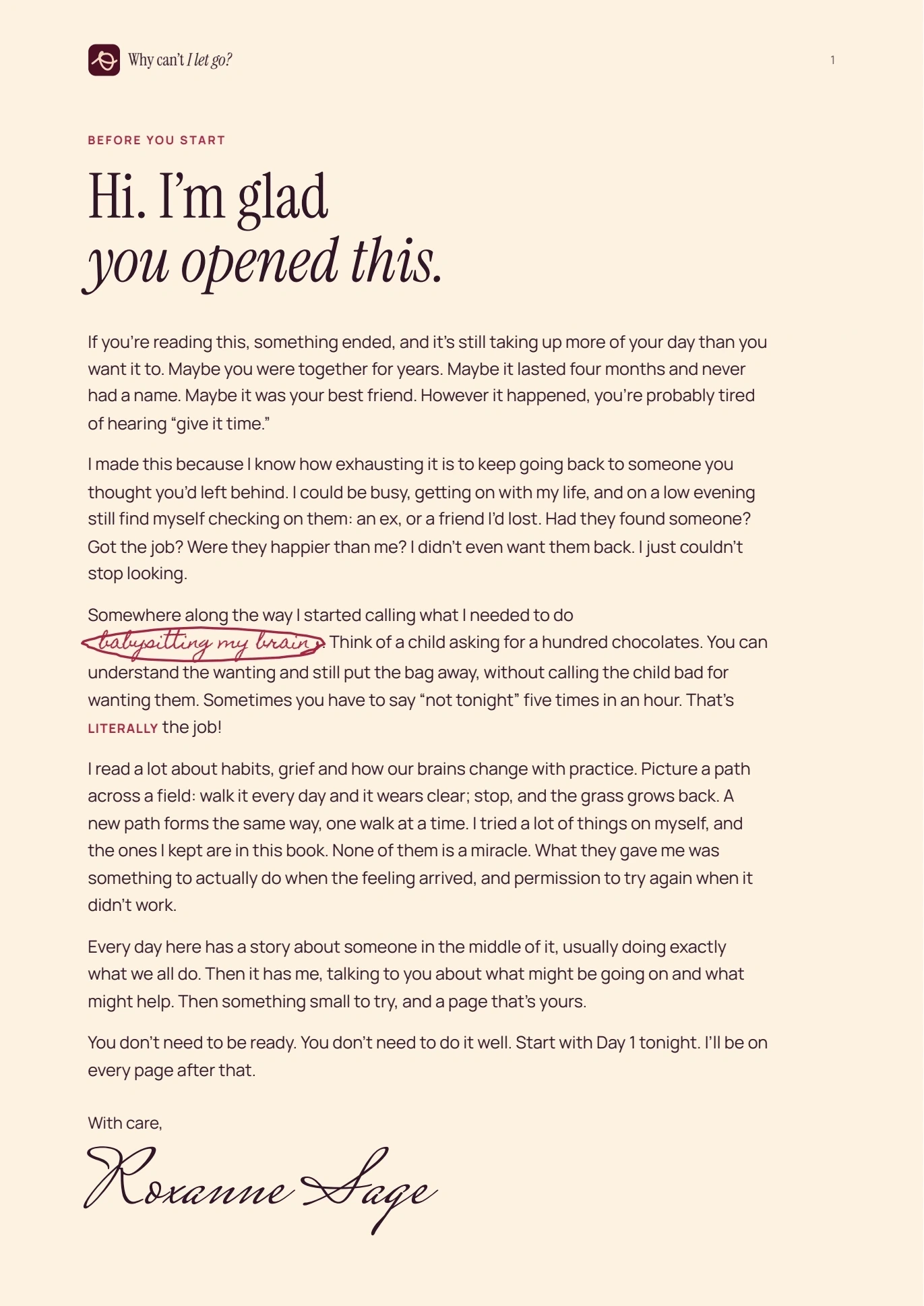
If you’re reading this, something ended, and it’s still taking up more of your day than you want it to. Maybe you were together for years. Maybe it lasted four months and never had a name. Maybe it was your best friend. However it happened, you’re probably tired of hearing “give it time.”
I made this because I know how exhausting it is to keep going back to someone you thought you’d left behind. I could be busy, getting on with my life, and on a low evening still find myself checking on them: an ex, or a friend I’d lost. Had they found someone? Got the job? Were they happier than me? I didn’t even want them back. I just couldn’t stop looking.
Somewhere along the way I started calling what I needed to do babysitting my brain. Think of a child asking for a hundred chocolates. You can understand the wanting and still put the bag away, without calling the child bad for wanting them. Sometimes you have to say “not tonight” five times in an hour. That’s LITERALLY the job!
I read a lot about habits, grief and how our brains change with practice. Picture a path across a field: walk it every day and it wears clear; stop, and the grass grows back. A new path forms the same way, one walk at a time. I tried a lot of things on myself, and the ones I kept are in this book. None of them is a miracle. What they gave me was something to actually do when the feeling arrived, and permission to try again when it didn’t work.
Every day here has a story about someone in the middle of it, usually doing exactly what we all do. Then it has me, talking to you about what might be going on and what might help. Then something small to try, and a page that’s yours.
You don’t need to be ready. You don’t need to do it well. Start with Day 1 tonight. I’ll be on every page after that.
With care,
Roxanne Sage
Your nervous system trusted them, maybe even rested with them, and now that’s gone. Therapy has its own place, but some days you need something to do today. Babysitting your brain means giving it small, steady things to do while it learns to settle, and keeping track of what helps, like you would with anything that matters.
Give your brain something to do. Pick the page that sounds like you, choose one exercise, and try it in 10 minutes. That’s all it takes to start.
30-day workbook · The Pocket Book: The Night Desk · The Traps · Field Guide · Start Here · fillable tracker. Downloadable PDFs. Read, write or print at your own pace.
A story, a personal note, one practice and a page for you. Choose the smaller version on a difficult day.
Borrow the calm of a night clerk. Follow a short set of steps while the hurting part of you gets some care.
Examine the evidence in twelve fictional cases and twelve cold cases. Each ends with a small tool to try in your own life.
Practical steps and words to use for shared places, their belongings, difficult dates and unexpected encounters.
One row a night: tick what you did, add your pull and mood, and see your progress on the same page. Fillable, phone and printable versions included.
That worn path is the one your brain keeps craving. It’s your life with them. Stop walking it, and the wild grass grows back.
means your brain builds new roads through repetition. Each small daily practice is a step on the new path, while the old one rests.
No. The workbook offers a sequence, but each day can stand on its own. Use the smaller practice, skip a day or return to an earlier one.
The workbook also speaks to friendship endings and connections that never had a clear name. The Field Guide has specific paths for friendship endings and ghosting. Choose the exercises that fit your circumstances.
Missing someone and questioning a decision can happen together. Day 13, “Was I Wrong?”, gives you a place to look at what you knew then and what you miss now.
Six PDFs: Start Here, the 30-Day Workbook, the Pocket Book: The Night Desk, the Field Guide, The Traps and the tracker. The tracker is a fillable PDF you complete in the free Adobe Acrobat Reader, and it prints on A4.
You can read the PDFs on your phone. The A4 pages are roomier on a tablet or computer, or in print. For interactive tracker calculations, follow the supplied Acrobat instructions; in-app browser PDF viewers may not support them.
Your kit includes the guided audio for Days 1–7. The full 30-day collection, with Days 8–30, is an optional $12 add-on on the order page.
There is no promised recovery timeline. These are self-guided practices to try and revisit. If the support you need is greater than a workbook can offer, professional support may be useful alongside it.
You pay once at our secure checkout, through PayPal. Within minutes an email arrives with your login to your private kit page, where you can download every piece in all three versions. Because the files are yours the moment you pay, all sales are final. If a file is broken or won’t open, email me and I’ll replace it within 48 business hours, or refund you if I can’t fix it. Full details are in the terms of sale.
Many people feel heartbreak in their body: a tight chest, a heavy stomach, broken sleep. Losing someone you were attached to can switch on your body’s stress response, and brain-imaging studies have found that rejection activates some of the same areas involved in physical pain. It’s a common, real reaction, not you being dramatic. The Pocket Book: The Night Desk in the kit gives you short steps for the moments it feels physical. If chest pain is severe, crushing, spreading to your arm or jaw, or comes with breathlessness, get medical help straight away. Don’t assume it’s grief.
Each check gives a small, unpredictable hit: sometimes relief, sometimes hurt, sometimes nothing. That uncertainty is exactly what keeps a habit going, the same pull as refreshing a feed. Willpower alone rarely beats a habit your brain has practised every day. What helps is noticing when the urge comes, having something else ready to do in that moment, and seeing on paper that the urges are getting fewer. That’s what the Pocket Book: The Night Desk and the Tracker are for.
There’s no set timeline, and a situationship doesn’t hurt less because it never had a label. Grief over something undefined can linger longer, because there was no clear ending, no shared story and often no one who knew how much it meant. Some people feel lighter in weeks, others take months. Instead of watching the calendar, notice whether the hard moments are getting a little shorter or less frequent. The kit’s Tracker is built to show you exactly that.
Trying not to think about them usually makes the thoughts louder. What helps more is giving them a set place. On Day 11 of the workbook, “The Appointment”, you give the questions and replays a short time slot each day, so they stop taking the whole evening. Day 3, “The Loop Has a Name”, helps you notice when thinking it through has turned into another replay.
The urge usually peaks and then passes, so the goal is to get through the next few minutes, not to decide your whole future. The Pocket Book: The Night Desk in the kit is built for exactly that moment: open it, follow a few short steps, and come back to the decision later. If there are words you need to get out, Day 12, “A Letter With No Address”, gives them somewhere to go without sending them.
When you miss someone, your mind plays a highlight reel: the best mornings, the inside jokes, the way it felt at the start. The difficult parts fade first. Day 8 of the workbook, “The Receipt”, helps you hold the whole picture, so you can miss what was good without forgetting what wasn’t.
It’s common to turn the pain into a verdict about yourself: too much, not enough, should have seen it. Day 9, “The Friend Voice”, has you describe what happened the way you’d describe it for a friend: honestly, without an insult attached. Day 16, “The Belief Session”, helps you look at a painful belief without treating it as the final word.
Being ghosted leaves you with questions nobody is going to answer, so your mind keeps filling in the gaps. Day 17, “Fact and Story”, helps you separate what actually happened from the story you’re filling in. The Field Guide has a separate set of pages for ghosting, for the moments when the silence gets loud.
Anger often shows up when something felt unfair, or when you didn’t get to say what you needed to. It’s allowed. Day 19 of the workbook, “Anger Is Allowed”, helps you work out what the anger is protecting and give it somewhere to go without sending or posting anything.
Have a plan before it happens. The Field Guide covers unexpected encounters, shared places and their belongings, with practical steps and a few words ready to say, so you’re not working it out on the spot.
Hard dates are easier when you see them coming. The Field Guide has pages for difficult dates, so you can plan the day ahead: who you’ll be with, what you’ll do and what you’ll do if it gets hard. The Tracker lets you mark the date and notice how it went.
Losing a friend can hurt as much as losing a partner, and people rarely talk about it. The kit is written for friendship endings too. The Field Guide has a friendship trail for the practical moments, like shared friends, group chats and places you used to go together.
Yes. There’s no deadline, whether it lasted four months or fourteen years. Missing someone months later doesn’t mean you’re going backwards. Instead of counting days, the Tracker shows you whether the hard moments are getting shorter or less frequent, and it records hard days as Grace days rather than a reset.
Why can’t I let go? (Full Kit) · $47Get instant access ➔